

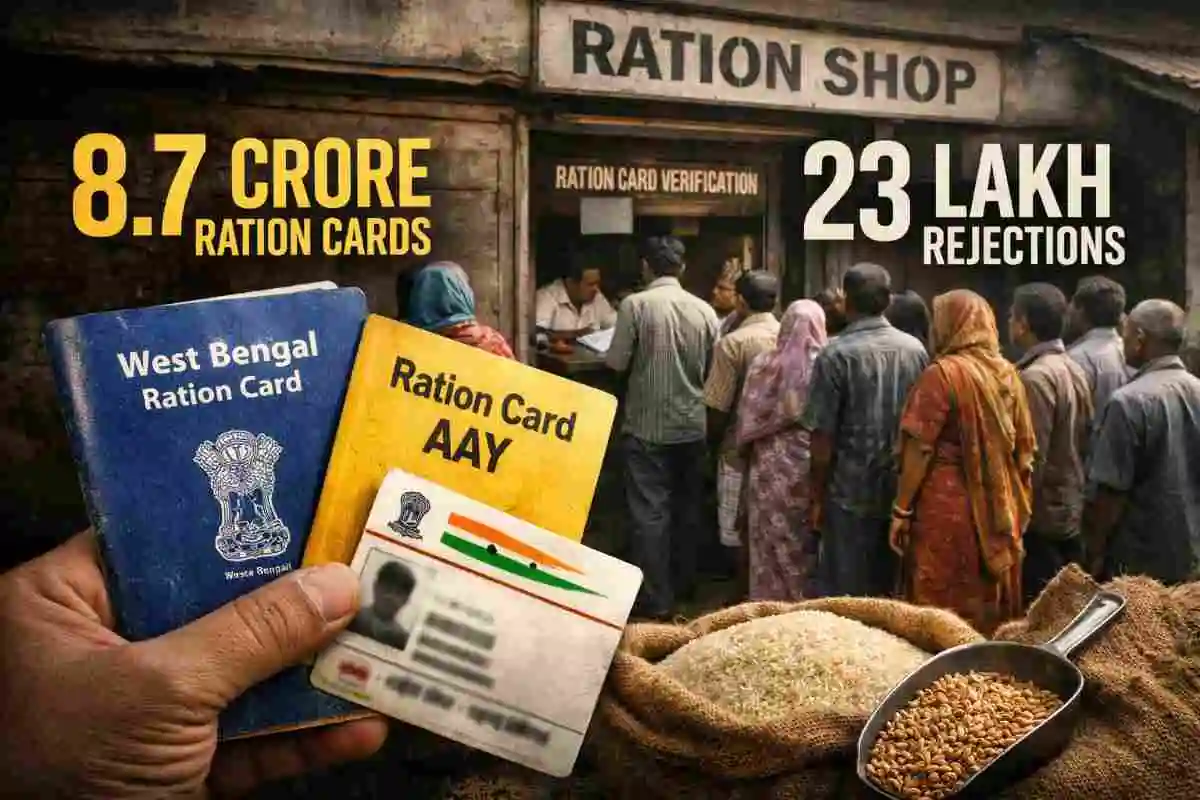
The West Bengal Public Distribution System (WBPDS) has published updated data showing 8.72 crore active ration cards registered in the state, while over 23 lakh applications for card-related services have been rejected since January 2021. The figures raise questions over coverage, eligibility verification, and whether eligible residents may be excluded from subsidised foodgrain access.
Key Figures from the WBPDS Dashboard
Below is a snapshot of the latest official data published by the Department of Food & Supplies, Government of West Bengal, on the status of ration card registration and related applications.
| Metric | Latest Figure | Notes |
|---|---|---|
| Total Ration Cards | 8,72,23,530 | All active cards as on the latest update (February 8, 2026) |
| Aadhaar-Linked Cards | 8,63,77,902 | Nearly all cards linked with Aadhaar biometric identity |
| Applications Rejected | 23,21,446 | Total disallowed applications for services since Jan 1, 2021 |
| Total Applications Processed | 2,87,61,449 | Includes approved and rejected cases |
Understanding the WBPDS System and the Numbers
The West Bengal Public Distribution System (WBPDS) is the state’s mechanism for managing ration cards, linking identities, and supplying subsidised foodgrains through fair price shops under national and state food security schemes. Cards permit households to access rice, wheat, sugar, and other essentials at fixed subsidised rates.
The official dashboard maintained by the Department of Food & Supplies shows continuous monitoring of card counts, Aadhaar linkage, application processing, and transaction data for distribution.
What the 8.7 Crore Figures Mean
An active tally of 8.72 crore ration cards suggests an extensive database of beneficiaries across West Bengal. Almost all these cards have been linked with Aadhaar, indicating high compliance with biometric identification norms.
However, interpreting this figure requires context. It reflects cumulative registered cards and does not in itself verify current eligibility under the National Food Security Act (NFSA) or other welfare standards. Some cards may belong to households that have moved, expired, or no longer meet income criteria.
Why 23 Lakh Applications Were Rejected
Since the beginning of 2021, more than 23 lakh applications for ration card-related services — such as new cards, updates, transfers, or corrections — have been rejected following scrutiny. Officials assert that rejections typically result from incomplete documentation, Aadhaar mismatch, inconsistent family details, or non-eligibility under scheme rules.
The dashboard records these rejections alongside approved applications, offering transparency in procedural outcomes.
Implications for Coverage and Subsidy Access
Exclusion of Eligible Residents?
While a high number of active cards indicates broad coverage, the volume of rejected applications has prompted questions about outreach and administrative access. Critics and welfare advocates contend that stringent documentation requirements — especially biometric verification — can inadvertently exclude lower-income or informal sector workers whose identity records or digital links may be inconsistent.
Several media reports have highlighted concerns that cards for daily wage earners and migratory labourers may be suspended when biometric data does not match perfectly, or when Aadhaar linkage fails. In some districts, this has reportedly left genuine beneficiaries unable to collect ration supplies despite entitlement under NFSA rules.
Administrative Verification vs. Welfare Coverage
Officials argue that rejections are necessary to maintain system integrity and prevent duplicate, fraudulent, or invalid records that could divert subsidised supplies. They emphasise that rigorous verification — including Aadhaar authentication — reduces leakages and ensures ration allocation is targeted.
However, welfare groups and legal advocates argue for safeguard mechanisms to ensure that procedural enforcement does not deny entitled citizens access to essential food security benefits.
Broader Context and Historical Challenges
West Bengal’s public distribution framework has faced scrutiny in the past for irregularities and bottlenecks. Historical reports on PDS operations have pointed to challenges including corruption, diversion of grain, and administrative inefficiencies — though the current digitised system aims to reduce such issues through traceability and real-time monitoring.
The expanded scale of Aadhaar linking and online application processing under WBPDS represents a significant administrative transformation. Yet, the balance between verification to prevent misuse and outreach to ensure inclusion remains a policy challenge.
What Residents Can Do
Residents affected by rejected applications are encouraged to:
- Review the rejection reason provided in their application status.
- Ensure accurate and consistent Aadhaar details.
- Reapply with complete documentation where gaps exist.
- Contact local Food & Supplies offices or helpdesks for clarification.
Frequently Asked Questions
What is WBPDS?
WBPDS is the West Bengal Public Distribution System managed by the state’s Department of Food & Supplies to issue ration cards and distribute subsidised foodgrains.
How many ration cards are active in West Bengal?
As of the latest official data, there are 8,72,23,530 active ration cards in the state.
Why were more than 23 lakh applications rejected?
Applications may be rejected for incomplete information, Aadhaar mismatches, invalid supporting documents, or ineligibility under official rules.
Does a rejected application mean loss of entitlement?
Rejection means a particular request was not accepted; residents can correct information and reapply as per the guidelines.
Read More: Final Voter List of West Bengal 2026 Sparks Massive Outrage — Thousands Report Missing Names Again

1 Comment
Pingback: Income Tax New Rules Spark Confusion — Here’s What You Must Do Before Filing | 1stheadline.Com